Recycling and Sustainability — Commercial Waste Bethnal Green
 Commercial Waste Bethnal Green is committed to developing an eco-friendly waste disposal area and a community-focused sustainable rubbish area that supports local businesses, protects neighbourhoods and reduces carbon emissions. Our approach to managing commercial refuse in Bethnal Green blends practical on-street collection strategies with responsible end-of-life processing. We emphasise separation at source, reuse and recovery so that businesses contribute to the borough's wider circular economy while meeting regulatory and environmental expectations.
To achieve measurable impact across the borough we set a clear recycling percentage target: our ambition is to reach a 70% commercial recycling rate for the Bethnal Green area within five years. This target applies to non-hazardous commercial streams including paper and cardboard, glass, metals, mixed plastics, and organics. By focusing on consistent segregation of waste, we aim to divert large volumes from landfill or incineration into reprocessing and reuse channels, reducing both local pollution and embodied carbon from supply chains.
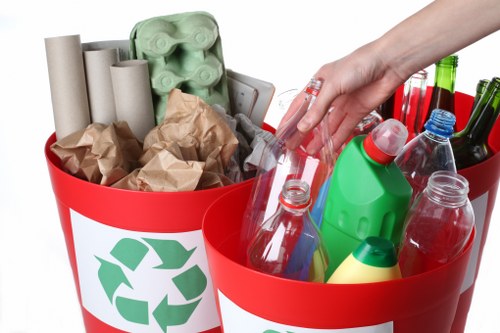 The Tower Hamlets approach to waste separation underpins our day-to-day work in Bethnal Green: the borough encourages businesses to separate food waste, mixed recyclables and residuals, and to handle bulky or electrical items via dedicated routes. For local commercial operators this means straightforward steps like keeping clean cardboard and paper out of general waste, providing a separate container for glass and metal, and collaborating on food-waste collections. These borough-led standards make it easier to deliver consistent recycling performance across the area.
Local transfer stations, partnerships and reuse networks
We partner with local transfer stations on the outskirts of the borough to minimise double-handling and short-haul trips. Containers collected from Bethnal Green are consolidated at nearby facilities where materials are sorted and prepared for onward recycling. Working with transfer stations in Poplar, Stratford and nearby London Logistics hubs allows us to scale collections without increasing congestion in the local streets, while ensuring that material quality remains high for reprocessors.
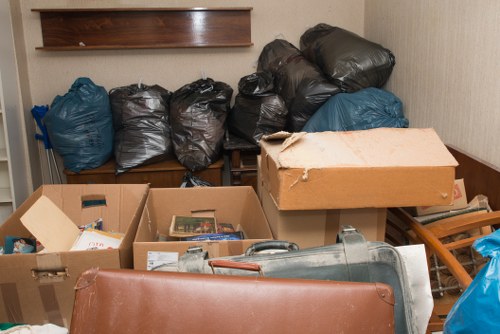 Our sustainable rubbish area model relies on strong community partnerships. We work with charities and social enterprises to maximise reuse: furniture, textiles and good-condition office equipment are diverted to third-sector partners before any residual disposal. Typical collaborations include:
- Furniture reuse programmes that refurbish and redistribute office desks and shelving to local charities;
- Textile and clothing collection schemes that keep fabrics circulating in the local economy;
- Small electrical appliance take-back and repair initiatives run in partnership with reuse organisations.
These partnerships not only support local households and voluntary projects but also help businesses demonstrate responsible procurement and social value in their sustainability reporting.
Low-carbon logistics and best-practice operations
Fleet decarbonisation is central to operating an eco-friendly waste disposal area. Our collection fleet for commercial rubbish in Bethnal Green increasingly features low-carbon vans and vehicles: electric vans, hybrid-assisted trucks and cargo bikes for micro-distribution in pedestrian or congested areas. By prioritising low-carbon vans and optimising collection routes, we reduce emissions, noise and local air pollution while improving reliability for businesses.
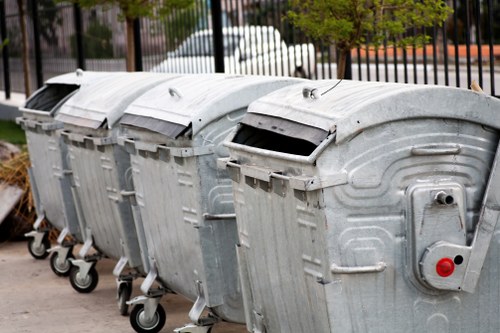 To support both the sustainable rubbish area concept and the borough's policies, we conduct regular waste audits with clients: audits inform container sizing, collection frequency and required separation streams. Audit results feed into a tailored waste management plan, ensuring that the 70% recycling target is pragmatic, measurable and steadily achievable. Metrics collected include tonnage, contamination rates and vehicle miles travelled.
 Beyond collections, we champion small operational changes that add up: replacing single-use packaging with reusable crates, coordinating shared compactors for neighbouring businesses, and running staff awareness sessions on segregation. These activities complement the borough's waste separation rules and create resilient supply chains that value materials over disposal. Through continuous improvement—measuring outcomes, addressing contamination and expanding reuse partnerships—we aim to make Bethnal Green a model for commercial waste in Bethnal Green that other London neighbourhoods can emulate.
Summary of commitments:
- Recycling percentage target: 70% commercial recycling across Bethnal Green within five years;
- Local transfer stations: consolidation at nearby Poplar and Stratford hubs to minimise local impact;
- Partnerships with charities: reuse, repair and redistribution programmes for furniture, textiles and small appliances;
- Low-carbon vans: electric and low-emission vehicles with route optimisation to cut CO2 and NOx;
- Borough alignment: adherence to Tower Hamlets waste separation practices and continuous audits to reduce contamination.
Our vision for a sustainable rubbish area in the heart of east London is practical and measurable. By combining operational changes, community partnerships and investment in low-carbon logistics, commercial waste in Bethnal Green can be transformed into a valuable resource stream — supporting jobs, reducing emissions and improving local environmental quality for everyone.
